

How an Experienced Bamboo Kitchenwares Manufacturer Eliminates Mass Production Defects
Sep 09, 2026
Mass-produced bamboo kitchenware defects including surface burrs, structural cracks, and fiber dark spots are avoidable via standardized full-process quality control. As a professional bamboo kitchenwares manufacturer, we implement four mandatory full-inspection nodes and strict AQL sampling protocols, keeping bulk order major defect rate below 0.2% for custom bamboo utensils bulk and wholesale wooden kitchenware shipments.
1. Core Mass Defect Pain Points in Bamboo Kitchenware Bulk Production
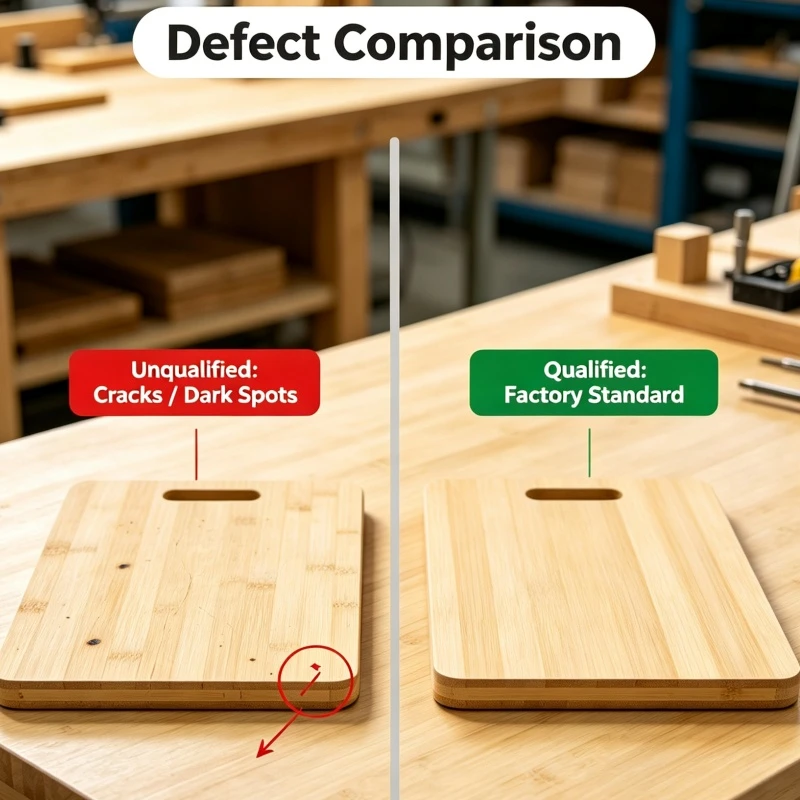
Most wholesale bamboo kitchenware negative feedbacks and batch rejections originate from three recurring manufacturing flaws: residual edge burrs after incomplete polishing, structural cracks caused by unbalanced moisture and hot-press pressure, and microbial dark spots from uncontrolled raw material storage. These issues appear concentrated in large-batch OEM orders and severely damage Amazon listing ratings and retailer brand reputation.
Generic factories rely on final finished-product random inspection, which cannot eliminate hidden defects generated during processing. Experienced bamboo kitchenware manufacturers build layered front-end process interception mechanisms to control quality from raw material to finished packaging.
| Common Mass Production Defect | Root Processing Cause | Retail Impact | Factory Control Standard |
| Surface Burrs | Inadequate multi-stage polishing, uncalibrated CNC tool offset | Consumer scratch complaints, low review scores | Zero burr tolerance for food-contact surfaces |
| Structural Cracks | Moisture content outside 8%-12% range, uneven hot-press pressure | Batch return, long-term usage failure | Pre-process moisture calibration & pressure locking |
| Fiber Dark Spots | Raw material damp storage, incomplete carbonization sterilization | Appearance inconsistency, unqualified visual inspection | Raw material batch screening & high-temperature treatment |
2. Four Full-Process Full-Inspection Nodes for Defect Interception
To stabilize bulk order consistency for custom bamboo utensils bulk and wholesale wooden kitchenware orders, we enforce four non-negotiable full-inspection nodes covering the entire production chain. Every single product undergoes process inspection instead of relying solely on final sampling, realizing in-process defect elimination.
2.1 Raw Material Cutting & Drying Inspection
All moso bamboo raw materials are screened for growth age and fiber uniformity before cutting. After precision slicing, materials enter constant-temperature drying chambers for gradient dehumidification. Professional pin-type moisture meters test each batch to lock finished material moisture content within 8%–12%. Materials exceeding the range are re-dried or eliminated directly to prevent post-production cracking and mold spots.
2.2 Hot-Press Lamination Quality Inspection
Bamboo board hot-press molding strictly adopts fixed parameters: 160℃ constant temperature, 12MPa stable pressure, and 15-minute constant pressure curing. Inspectors fully check board flatness, glue line uniformity and delamination risks after hot pressing. Unbalanced pressure and uneven gluing are the main causes of later-stage structural deformation, which are completely intercepted in this node.
2.3 CNC Precision Carving Dimension Calibration
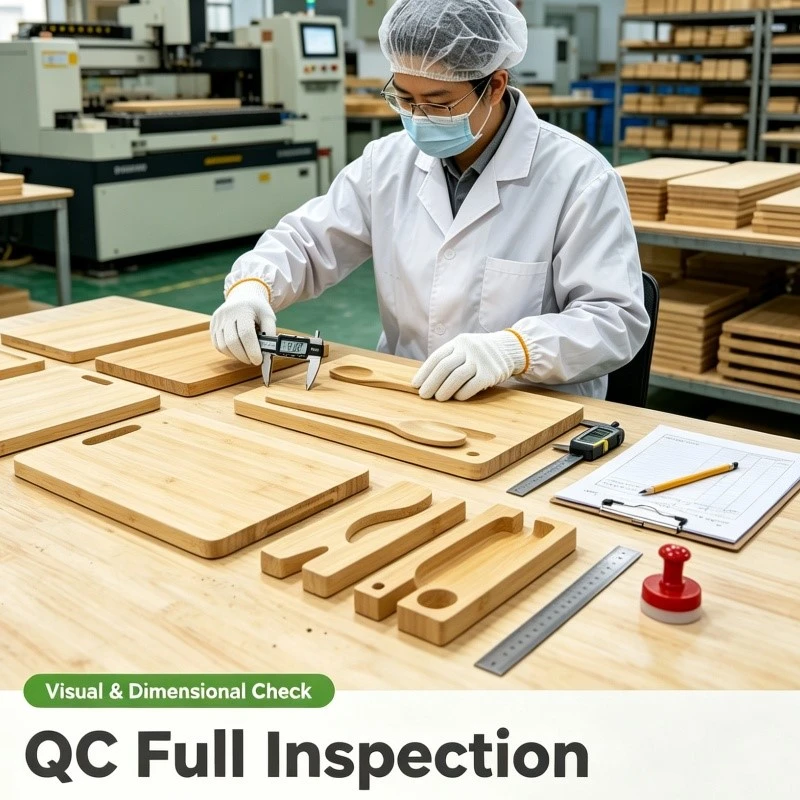
All bamboo utensils and kitchenware shaping adopts CNC integrated carving process. The factory calibrates tool offset and program tolerance before each batch production, controlling overall dimension tolerance within ±0.4mm and edge flatness error below 0.1mm. Full inspection removes products with tool marks, edge gaps and irregular radian to eliminate burr defects fundamentally.
2.4 Finished Surface Treatment & Polishing Inspection
Finished products undergo three-stage fine polishing: 240-grit rough grinding, 600-grit fine grinding and 1000-grit mirror finishing. Food-contact surfaces are fully inspected for residual burrs, scratches and dark spot flaws. Qualified products proceed to food-grade mineral oil or beeswax surface sealing to form stable protective layers.
Avoid inconsistent quality in bulk bamboo orders?
Browse Standard Bamboo Kitchenware Line
3. Strict AQL Sampling Standard for Bulk Shipment Consistency
For large-volume wholesale wooden kitchenware and custom bamboo utensils bulk orders, full inspection cannot replace standardized sampling verification for batch stability. Our factory strictly executes international AQL 2.5 Major / 4.0 Minor quality acceptance standards for all pre-shipment inspections, unifying quality evaluation criteria for cross-border bulk orders.
3.1 AQL Defect Classification Rules
Major defects (AQL 2.5) include structural cracks, food-contact surface burrs, obvious delamination and abnormal dark spots that affect usage and safety. Minor defects (AQL 4.0) include tiny surface tool marks, slight color difference and minor texture unevenness that do not affect product function and compliance.
3.2 Bulk Order Sampling Execution
According to batch volume, QC teams extract random samples from multiple production pallets and container loading areas to avoid localized quality deviation. Once sampling exceeds the AQL threshold, the entire batch will undergo secondary full inspection and rework. This mechanism ensures uniform appearance, structure and performance of every shipping batch for global retailers.
Under this standard, our bulk order comprehensive defective rate is steadily controlled below 0.2%, fully meeting Amazon FBA inspection and EU/US retail market access requirements.
Need verified AQL inspection reports for bulk orders?
Request Factory QC Standard Document
FAQ for Bamboo Kitchenwares Bulk Manufacturing & Quality Control
01. How does your factory eliminate burr defects on bamboo kitchenware?
02. What sampling standard do you use for bulk bamboo kitchenware shipments?
03. Why are your bamboo products free of dark spots and cracks in bulk production?