

Scale Up Production - How Bamboo Capitalizes on Rapid Growth Cycles to Stabilize B2B Supply Chains
Oct 21, 2026
Global hardwood log export restrictions and 27–42% lumber price volatility from 2022–2025 create recurring raw material shortages for wood tableware and packaging. Moso bamboo harvested at 3–5 years provides a continuously renewable fiber source with consistent Janka hardness 1380 lbf after cross-lamination engineering, eliminating multi-decade timber regeneration risk. Our factory maintains moisture content 8–12% through kiln carbonization to reduce container rain and mold risk during ocean transit.
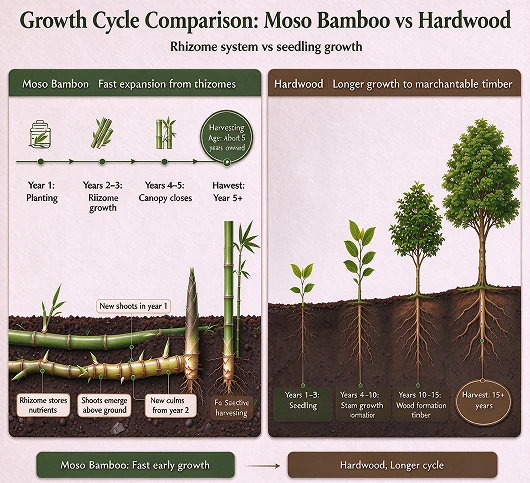
1. Growth Cycle Comparison: Moso Bamboo vs Hardwood Timber
Moso bamboo is a grass species, not timber, with rhizome network self-regeneration after selective harvest. No replanting required post-cut. Conventional hardwoods require 30–50 years before commercial felling, with harvest quotas restricted by FSC-CoC forest management rules.
| Material | Commercial Maturity Cycle | Janka Hardness | Regeneration Mechanism | Typical Moisture Range Post Kiln |
|---|---|---|---|---|
| Moso Bamboo (cross-laminated) | 3–5 years | 1380 lbf | Rhizome network, no replanting | 8–12% |
| Acacia Hardwood | 12–18 years | 1750 lbf | Sapling replanting | 10–14% |
| Oak / Teak Hardwood | 30–50 years | 1360–1160 lbf | Seedling replanting | 11–15% |
2. Raw Material Sourcing & Strategic Stock in Fujian Bamboo Core Zone
Our factory operates direct procurement from certified FSC-CoC bamboo forests in Fujian. Annual harvest quotas are locked 24 months in advance. We maintain 6-month rolling raw material buffer inventory for peak wholesale seasons, avoiding spot-market price spikes.
All incoming culms undergo moisture screening before carbonization. Material failing 8–12% moisture target is rejected for finished food-grade production. Cross-lamination engineering aligns fiber interlocking mechanism to reduce warping and shrinkage below 0.4% after ISTA-1A drop testing.
3. Supply Chain Defect Control & Shipment Compliance
AQL 2.5 Major control applies to all finished bamboo goods. Inspection covers surface cracking, delamination, moisture deviation, and mineral oil sealing integrity. Fumigation or phytosanitary certificates are issued for shipments entering regions requiring phytosanitary clearance.
Container rain mitigation protocol includes container rain desiccant packs and PE bubble bag + inner carton + outer export carton triple packaging. For mixed orders, bamboo items and bagasse pulp packaging share the same container loading workflow. Bagasse pulp meets EN13432 and ASTM D6400 compostability standards for retail and food service packaging lines.
4. ESG Audit & Carbon Footprint Benchmark
Bamboo carbon sequestration rate exceeds hardwood timber during active growth. FSC-CoC chain-of-custody documentation, PFAS screening reports, and food contact certification (FDA/LFGB) are available for ESG audit submission. Annual third-party SGS testing covers heavy metal extraction and surface coating safety.
Need verified AQL inspection reports for bulk orders?
Request Factory QC Standard Document
FAQ for Bamboo Kitchenwares Bulk Manufacturing & Quality Control
01. Is fumigation certificate mandatory for bamboo product shipments?
02. What is your minimum MOQ for wholesale bamboo OEM orders?
03. What quality control standard applies for bulk bamboo goods?