

The Total Cost of Ownership Matrix - Transitioning Supply Chains from EPS to Molded Sugarcane Pulp
Nov 12, 2026
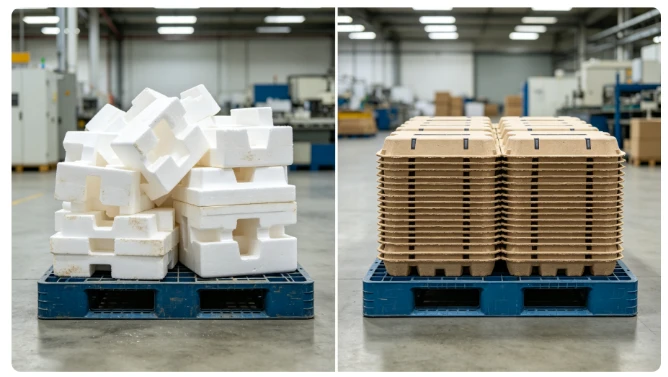
Unit price alone does not define packaging procurement economics. EPS shows lower per-piece invoice cost but carries inflated container utilization penalties, regional plastic tax liabilities and measurable ESG depreciation. Molded sugarcane pulp delivers lower total cost of ownership when freight, warehousing and regulatory charges are included for high-volume retail and electronics shipments.
Full-Lifecycle Procurement Cost Matrix
| Cost Dimension | Expanded Polystyrene (EPS) Packaging | Molded Sugarcane Bagasse Pulp |
|---|---|---|
| Warehouse & Container Cube Footprint | Low nesting ratio; occupies 3–4x more ocean and 3PL storage volume | High-density nesting ratio; cuts per-unit freight amortization |
| Regional Plastic Tax Exposure | Liable for per-ton plastic levies across EU, UK and select US state jurisdictions | Zero-rated under most plastic tax frameworks; eligible for limited green procurement incentives |
| Brand & ESG Financial Impact | Consumer rejection risk; no measurable green margin support | Improves corporate ESG audit scores; enables 5%–15% verified green price premium on finished SKUs |
| Inbound Damage Claims | Static charge risk for electronics; brittle under low-temperature cycling | Fiber interlocking mechanism; passes ISTA-1A drop testing without static transfer |
| End-of-Life Disposal Fees | Separate landfill or incineration surcharges apply | Home and industrial compost compliant to EN 13432, ASTM D6400 |
Hidden Supply Chain Variables That Shift TCO
Per-unit pricing quotes exclude recurring logistical overhead that compounds on 40HQ and 20GP container runs. EPS cannot be nested without custom secondary frames, which add labor and increase the chance of in-transit crushing. Molded pulp tooling is engineered with matched male-female draft angles for stable stacked nesting, with controlled wall thickness between 1.8 mm and 3.2 mm depending on cushion grade.
Moisture content is held at 7%–10% post hot-press curing for export lots. Container rain desiccant load rates are calibrated for 40-day ocean transit windows to prevent surface fiber distortion. All production runs maintain AQL 2.5 major defect control for nesting profile consistency.
Regulatory and Audit Documentation Requirements
Buyers reporting ESG scope 3 emissions must capture packaging material classification. EPS falls under fossil-based plastic accounting. Bagasse pulp is classified as biogenic fiber feedstock, traceable to cane mill supply chains with batch-level material declarations. Our factory provides test certificates aligned to EN 13432, FDA food contact and LFGB for food-facing molded pulp items. Third-party audit packs can be prepared for your internal ESG review teams on bulk wholesale orders.
Secure compliant test packs for your ESG audit cycle
FAQ
01. Does molded bagasse pulp require higher minimum order volumes than EPS inserts?
02. Can sugarcane molded pulp replace EPS for ISTA 2A certified electronics packaging?
03. Will destination customs treat bagasse pulp as paper or plastic for tariff coding?